Wednesday, February 1, 2012
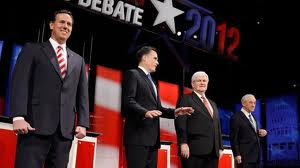
Will a lengthy Republican primary help or harm the GOP?
As the race for the 2012 Republican nomination continues, many have asked if a long, drawn out primary campaign will hurt the GOP heading into the general election in November? Newt Gingrich has vowed to stay in the race through the convention, regardless of the outcome of the remaining primaries and caucuses. If the former Speaker's new campaign slogan, 6 states down, 46 to go is any indication, the Gingrich campaign bus will continue racking up the miles. Those who would like to see the nomination wrapped up sooner rather than later will say that a long primary race will weaken the Republican party and the eventual nominee. Those who hold this belief may point to recent polls that indicate that every time the Republican candidates debate each other, the favorability of the candidates and the party goes down. Many Republicans fear that the constant back and forth attacks will possibly drive voters away from their prospective candidate. Also, supporters of a short primary season would say that the earlier the nomination is secured, the more time the nominee would have to attack President Obama and his policies of the last three years. At the same time, many would argue that a lengthy primary campaign could strengthen the eventual nominee by ensuring that he is "battle tested" heading into the general election. In the 2008 Democratic primary, Barack Obama and Hillary Clinton battled for months before Obama finally wrapped up the nomination in June of that year. Those close to the president would say that the lengthy primary fight with Hillary Clinton actually made the president a stronger candidate, not the other way around. I guess it is safe to say that only time will tell if a long, drawn out primary will help or harm the GOP.
Sunday, January 29, 2012
The Buffett Rule
Last Tuesday, President Obama laid out his legislative vision for the year ahead in his State of the Union address. One of the more interesting and intriguing elements of the speech was the so-called, "Buffett Rule." For those that may not know, the "Buffett Rule" is named after billionaire businessman and investor Warren Buffett. The president is proposing that all Americans should pay their fair share in taxes as a way to generate revenues to help bring down the deficit. The "Buffett Rule" would do just that. The concept of the "Buffett Rule" comes from the fact that Warren Buffett's secretary pays a higher tax rate than Buffett himself. According to the President, this just isn't right. Why should we expect someone in the middle class to pay more taxes than a billionaire? The president will most likely have a difficult time trying to convince some Americans that the "Buffett Rule" is just what America needs to help solve our economic and financial woes. Opponents of the rule will say that the president is trying to punish those who achieve financial success. In essence, punishing those who have achieved the "American Dream." Some will claim that the president is trying to wage class warfare, while others will say that such a rule will lead America down the path of socialism. Supporters of such a rule would say that those who can afford to pay a little more, should. The president doesn't want to punish success, and he flatly rejects the notion of such a provision constituting class warfare. President Obama simply wants to see the middle class in this country grow stronger by having more Americans sacrifice a little of themselves for the greater good of their country.
Friday, January 27, 2012
The Final Four
As the race for the 2012 Republican nomination heats up, I thought it would be appropriate at this time to take a closer look at the four contenders who remain. Former Massachusetts governor Mitt Romney, who has long been dubbed the proverbial front-runner, now faces a challenge from former House Speaker Newt Gingrich. Much of the Gingrich surge can be attributed to the personal attacks that Gingrich has leveled against Romney as a result of Romney's association with Bain Capital. Also, many Republicans are looking for a candidate who can go toe to toe with President Obama in the upcoming general election campaign. To many voters, that candidate is Gingrich. Many republicans simply feel as though Mitt Romney is not "tough enough" to take on the president. Despite the fact that Gingrich is viewed as the tougher of the two politically, many voters believe that Gingrich has too much "personal baggage" to win the nomination. As many know, the former speaker resigned his leadership position in the House due to a number of ethics violations. Much has also been made of Gingrich's three marriages, with his second wife alleging that Gingrich asked her for an "open marriage." Campaigns usually come down to the public's perception of a potential candidate. It will be very interesting to see if voters pay much attention to Gingrich's past when determining whether or not they will vote for him. Rick Santorum and Ron Paul, although still in the race, will most likely be non-factors as the race moves forward. Santorum recently stated that his campaign is broke, and he is tired, but vows to press on. Ron Paul has not seriously contested the race in Florida, and has turned his attention to upcoming caucus states such as Nevada and Maine. As a self proclaimed political junkie, it has been quite refreshing to see the energy and enthusiasm that Paul's campaign has generated. Ron Paul's message has resonanted with millions of Americans, especially younger voters. Unfortunately for Paul and his supporters, the media and those within the Republican party simply don't view his candidacy as legitimate. It is my belief that Mitt Romney will be the eventual nominee of the Republican Party. Although Romney doesn't have widespread support among true conservatives within the Republican ranks, he has gained the support of many members of the so called Republican establishment, namely Arizona senator and former Republican nominee, John McCain. Romney has also received the endorsement of former Kansas senator and 1996 Republican nominee Bob Dole. Without the support of the Republican base, and many members of the Republican establishment, combined with his personal issues, I just find it difficult to see a pathway to the nomination for Newt Gingrich. As mentioned earlier, Santorum and Paul both are non-factors at this point, and neither will be the nominee of the Republican Party. That leaves Romney as the last man standing to take on President Obama in November.
Sunday, August 28, 2011
A monument fit for a King
Today marks the forty-eighth anniversary of Martin Luther King Jr's. famous "I Have a Dream" speech. The speech was delivered on the steps of the Lincoln Memorial during the March on Washington in 1963. As Americans, we owe a debt of gratitude to Dr. King for the work he did to help our nation overcome the evils of segregation and racial injustice in the 1950's and 1960's. From Birmingham to Selma, Selma to Montgomery, the work of Martin Luther King Jr. lives on. It was Martin Luther King Jr. who challenged us to look beyond one's color so that we could focus on one's character. Dr. King knew the journey towards racial equality would not be an easy one. We hear evidence of this in the last speech that Dr. King ever gave. It came on the night of April 3rd, 1968 in Memphis, Tennessee. In that speech, Dr. King famously said, "we've got some difficult days ahead. But it doesn't matter with me now. Because I've been to the mountaintop, and I don't mind. Like anybody, I would like to live a long life. Longevity has its place. But I'm not concerned about that now. I just want to do God's will, and he's allowed me to go up to the mountain, and I've looked over, and I've seen the promised land. I may not get there with you. But I want you to know tonight, that we, as a people will get to the promised land." With the opening of the Martin Luther King Jr. memorial this past week on the national mall in Washington D.C., our nation has finally paid tribute to one of it's most influential leaders. I can't think of someone more deserving of such an honor, an honor that is long overdue. Very few, if any, have changed the course of history the way that Martin Luther King Jr. has. While King spoke of longevity in life, he was never able to achieve it. The memorial honoring Dr. Martin Luther King Jr. will not only provide the longevity that King sought in life by immortalizing the work of the late civil rights icon, it will also cement his legacy as a drum major for justice.
Wednesday, August 10, 2011
Crisis in Somalia
The situation is becoming more serious by the day in the east African country of Somalia. The region is experiencing one of the worst famines since the 1990's. Thousands of Somalis, including children, are dying from lack of food and water. When crises such as the current one in Somalia emerge, the United States never hesitates to offer our support . Some might say that the United States should take action now to help end the suffering for the people of Somalia. Given the current financial state of our country, one has to ask if we have the means to offer the necessary humanitarian support? There are many in America who would suggest that it is time for the United States to start taking care of its own people. Rather than worry about those who are starving in Africa, we should worry about those who are starving right here at home. The people of America are a kind and generous people. Many of us have a strong desire to want to reach out and assist those who need it the most. For hundreds of years, the United States has been a beacon of hope to so many nations in need. Despite the economic difficulties that we face, I believe that it is important that we never lose sight of that fact. Under the current circumstances, those of us in America who might want to assist the people of Somalia, might have to do so on our own. Private donations and offerings may be the best way to lend our support. A multi-billion dollar relief package from the U.S. government is just not possible at this time. As the crisis in Somalia continues, it is important that we continue to show concern and compassion for the people of this country in their time of extreme need.
Tuesday, August 9, 2011
The resignation of Richard Nixon
"Therefore, I shall resign the Presidency effective at noon tomorrow." These words were spoken by President Richard Nixon thirty-seven years ago today. With these words, Richard Nixon became the first and only president in U.S. history to resign. As most people know, Nixon's resignation came in the aftermath of the Watergate scandal. Following the break-in at the Watergate office complex, President Nixon denied any involvement, and claimed that he had no knowledge of what had taken place. President Nixon was eventually implicated in the scandal, and made the decision to resign on August 9, 1974. History has shown that President Nixon did not reach this decision easily. He was determined to stay in office despite all of the controversy surrounding him. Ultimately, the outside pressures became too much, and facing certain impeachment, the President did the only thing that he could. While I am disappointed in the actions of President Nixon, I commend him for his decision to resign. He knew the implications that impeachment would have on the nation, and he didn't want to put the American people through that. In his resignation speech, President Nixon stated that America needs a full time President. He knew he could not effectively govern the nation while facing impeachment. Presidents often speak about what their legacy will be. Almost every President wants history to remember them fondly. Unfortunately, Richard Nixon's legacy will forever be linked to the scandal that was simply known as Watergate.
Monday, August 8, 2011
Does religion have a place in the political world?
Does religion have a place in the political world? It is a question that dates back to the beginning of our republic, and has been one of the most hotly debated topics ever since. As a supporter of the concept of separation of church and state, I personally believe that a politician's religious views should not influence their decision making. Likewise, a religious organization should not use its position to influence one's political thinking. We have to have a mind of our own. We have to be able to think for ourselves. One might ask, why have religion and politics become so intertwined? The answer lies in the fact that certain political issues have serious moral and ethical implications in the eyes of some. For example, abortion violates one of the most sacred commandments, "thou shalt not kill." Opponents of gay marriage would most likely say that their opposition is due in large part to the fact that the bible says homosexuality is a sin. I have visited a church where the pastor/priest used the pulpit to try to influence the political thinking of the congregation. I told my wife, never again. Never would I step foot in that church again, and so far I haven't. I have a lot of respect for those who have a deep faith. I consider myself a deeply religious person. However, there is a time and place for everything. In my view, church is not the time, nor is it the place to try to influence one's political beliefs.
Subscribe to:
Posts (Atom)