Friday, June 28, 2013

Does America still need the Voting Rights Act?


The America that we knew in 1965 was a much different America than the one we know today This  was the basic belief of the five United States Supreme Court Justices who sided with the majority when the court struck down key provisions of the historic Voting Rights Act this past  Tuesday. As Chief Justice John Roberts said when explaining the ruling, "our country has changed for the better." If Roberts' assessment of our nation is correct, then one can't help but ask, does America still need the Voting Rights Act, or has the law essentially become outdated? When the historic civil rights legislation was signed by President Lyndon B. Johnson in 1965, poll taxes, literacy tests, and grandfather clauses were the norm. As a result of these practices, thousands of minority voters were disenfranchised all throughout the south. The Voting Rights Act sought to change all that, and did by requiring federal oversight of voter registration in certain southern states if discrimination was presumed. That was then. Many in support of overturning the law would argue that the forms of discrimination that prevented minorities from exercising their right to vote in 1965 are no longer in existence, and if the law was designed to help eliminate those discriminatory practices, then the law served its purpose, and is no longer needed. Those who support keeping all sections of the law intact would say that in eliminating federal oversight of the electoral process in the south, the court is opening the door for continued discrimination of minority voters, just in different ways. This decision now enables a handful of southern states to set their own election laws without having to gain approval from the federal government first. Many legal experts have suggested that because of the decision by the court, many states in the south will implement stricter voter ID laws which could possibly suppress voter turnout among minorities. It has also been suggested that Tuesday's ruling could lead to gerrymandering or the redrawing of congressional districts for the sole purpose of hurting minority voters. I for one, applaud the progress we have made as a country since 1965 on this issue. None of us should rest until all forms of discrimination in voting are eliminated. Tuesday's ruling by the United States Supreme Court leaves me with mixed feelings. On one hand, I can understand and appreciate the argument that we are a changed nation, and certain provisions of this law are no longer needed. On the other hand, if the elimination of certain sections of the law open up the possibility of discrimination occurring once again, I would have a hard time believing that the Supreme Court made the right decision.

Tuesday, June 11, 2013

Standing in the Schoolhouse Door


During the Civil Rights Movement of the 1960's, several showdowns occurred between state and federal authorities over the issue of segregation in the south. One of the most famous of these happened fifty years ago today on the campus of the University of Alabama at Tuscaloosa. It was on June 11th, 1963 that Alabama Governor, George Wallace, who was an ardent segregationist, stood in the doorway of Foster Auditorium to prevent African-American students Vivian Malone and James Hood from enrolling at the University. Wallace's act of defiance that day left President Kennedy no choice but to take action. After hearing of Governor Wallace's actions, Kennedy moved to federalize the Alabama National Guard in order to get Wallace to move. After being confronted by Deputy Attorney General Nicholas Katzenbach and the National Guard, Wallace stepped aside and Malone and Hood became the first two African-American students to attend the University of Alabama. In the years following the schoolhouse door incident, George Wallace would make four unsuccessful runs for the presidency, running three times as a Democrat, and once as an Independent. It was during his 1972 campaign that Wallace's life would change forever. While visiting with potential voters at the Laurel Shopping Center in Laurel, Maryland, George Wallace was shot five times at close range. The wounds he sustained would leave him paralyzed from the waist down and confined to a wheelchair for the rest of his life. It was his near assassination that helped to change Wallace's outlook on a number of issues including his views on segregation. In 1979, when asked about his stand in the schoolhouse door back in 1963, Wallace said, " I was wrong. Those days are over, and they ought to be over." It's safe to say that by the end of his life, George Wallace was a changed man. An amazing transformation indeed for a man who once claimed, "segregation now, segregation tomorrow, segregation forever." Governor George Corley Wallace died on September 13th, 1998 at Jackson Hospital in Montgomery, Alabama. He was 79 years old.

Monday, June 3, 2013

History's Mysteries


With the recent news that the Amelia Earhart disappearance may have finally been solved with the discovery of part of a plane that may have belonged to her, I began to wonder... what would the average American consider to be the greatest unsolved mystery in the history of the United States? For me, it would be the assassination of President John F. Kennedy. As many know, the Warren Commission concluded that Lee Harvey Oswald acted alone in the assassination of President Kennedy. However, in the years following the president's death, the report's findings have been questioned by many who believe the death of John Kennedy was part of a larger conspiracy. Numerous conspiracy theories have emerged over the years that have attempted to explain who shot the president. As much as I would like to believe the official government report, I have a hard time doing so. In my view, there had to have been at least two shooters taking aim at the president that November day in 1963, and more than one shooter would indicate conspiracy. I am more convinced today than ever before that the real truth about what happened that day in Dealey Plaza in downtown Dallas will never be known, thereby making the Kennedy assassination a mystery of history that will possibly never be solved. While the Kennedy assassination has fascinated Americans for decades, other unsolved mysteries of U.S. history have baffled the minds of many for quite some time as well. Some of these would include, the lost colony of Roanoke, the possibility that Bigfoot really exists, and the Roswell U.F.O. incident. To completely understand history, facts are a necessity. Unfortunately, when it comes to some of the more interesting mysteries of U.S. history, all of the facts are just not known. Perhaps with the passage of time, new evidence will come to light that will help solve some of these uncertainties. In the meantime, we can continue to speculate what may or may not have happened when it comes to these particular events. Isn't that part of the fun of learning about history...to try and figure out what MIGHT have happened when we don't really know the whole truth? I think we all can agree that our nation's history is chalked full of mysterious moments. What we might not agree on is which of those moments deserves the most attention. What moment in history would that be for you?

Thursday, February 21, 2013

Remembering Malcolm X


Forty-eight years ago today, America lost one of it's strongest voices for civil rights with the death of El-Hajj Malik El-Shabazz, better known as Malcolm X. He was born Malcolm Little on May 19, 1925 in Omaha, Nebraska. Throughout his childhood, Malcolm's family would relocate to Milwaukee, Wisconsin and later to Lansing, Michigan. After the death of his father, Malcolm's mother was institutionalized when Malcolm was just thirteen. Due to the difficult circumstances involving his mother and father, Malcolm was sent to live in a number of different foster homes during his formative years. He was an excellent student with a brilliant mind, but dropped out of school after a white teacher told Malcolm that becoming a lawyer was "no realistic goal for a nigger." Malcolm soon came to believe that American society in the 1930's and 1940's offered no real possibilities for a young black man like himself. As a result, Malcolm moved to Boston, and then Harlem where he became involved in a life of crime that included drug dealing, gambling, and robbery. Due to his involvement in these activities, Malcolm was sentenced to eight to ten years in the Charlestown State Prison. It was during his time in prison that Malcolm was introduced to the teachings of Elijah Muhammad and the Nation of Islam. Malcolm rose quickly through the ranks of the Nation, and was named a national minister for the organization. During his time as a minister for the Nation of Islam, Malcolm was seen as a controversial figure due to his outspoken nature and his message of black separatism. One of Malcolm's more controversial remarks surrounded the assassination of President Kennedy when Malcolm said that Kennedy's death was like the "chickens coming home to roost." For these remarks, Malcolm was silenced for ninety days by the Nation of Islam. During his silencing, Malcolm was not allowed to make any comments to the press or make any speeches at the Nation's temples. In 1964, after a falling-out with Elijah Muhammad and the Nation of Islam, Malcolm broke all ties with the organization. It was in this same year that Malcolm made his Hajj (pilgrimage) to the holy city of Mecca. Malcolm's pilgrimage was truly a transformational moment for him. His views toward race relations in America changed forever when he noticed blond-haired blue-eyed Muslims interacting as equals with black-skinned African Muslims like himself. Malcolm truly believed that if it could work in Mecca, why not in the United States? Malcolm spent much of the rest of 1964 traveling the world spreading his message. Upon his return to the United States, Malcolm formed the Muslim Mosque Inc. and the Organization of Afro-American Unity to promote a more racially harmonious message. The one and only meeting between Malcolm X and Martin Luther King Jr. occurred in 1964 as well. The two civil rights icons briefly encountered one another outside of the U.S. Senate after listening to debates on the historic civil rights bill. Malcolm's life came to a tragic end on February 21st, 1965. As Malcolm took to the podium in the Audubon Ballroom in Manhattan, New York to address a meeting of the Organization of Afro-American Unity, shots rang out killing the famed civil rights leader almost instantly. As we honor and celebrate the achievements of many African-Americans during Black History Month, may we never forget the lasting contributions of the one whom many refer to as one of the greatest and most influential African-Americans in United States history.

Thursday, February 14, 2013

The Five Greatest?


Since President's Day is right around the corner, I thought I would share with you my list of the top five presidents in United States history. While every president is unique in their own right, I feel that these men have set themselves apart as the best to ever occupy the oval office.

#5  Harry S. Truman: Often referred to as the accidental president, Truman initially assumed the office in April of 1945 after the death of the seemingly immortal Franklin Delano Roosevelt. Truman came from very modest beginnings. Harry Truman had tried his hand at farming, but had little luck. With the country on the verge of the Great Depression, his haberdashery business went under as well. With the help of Kansas City political boss Tom Pendergast, Harry was elected as a judge for eastern Jackson County. From there, Truman went on to win election to the United States Senate in 1934, representing Missouri for ten years until FDR asked Truman to join him on the Democratic ticket in time for the 1944 presidential election. Harry Truman served as vice-president for only 82 days before becoming president of the United States at one of the most trying times in U.S. history. Harry Truman's presidency was marked by one major decision after another. From the dropping of the atomic bombs on Hiroshima and Nagasaki, to the desegregation of the armed forces, to the recognition of Israel, to the sending of troops into Korea, to the firing of Douglas MacArthur, President Truman no doubt showed the world that the buck did indeed stop with him.

#4  Theodore Roosevelt: The president who spoke softly and carried a big stick will always be remembered as one of America's greatest. Teddy, as he came to be known, entered the presidency in 1901 after the assassination of William McKinley. Roosevelt quickly began to push an agenda that focused on progressivism, conservation, and a number of other key issues. It was Theodore Roosevelt who was the force behind the completion of the Panama Canal which helped to revolutionize trade around the world. Due to his desire to place tighter restrictions on businesses, Teddy came to be known as the "trust buster." In 1910, Theodore Roosevelt was at odds with his friend and president at the time, William Howard Taft. The disagreements that Roosevelt had with Taft led Teddy to form the Bull Moose Party in 1912. Roosevelt ran as that party's candidate for the presidency, but ultimately lost out to Democrat Woodrow Wilson. Given Theodore Roosevelt's great intellect and intuition, it should come as no surprise that the former rough rider was able to ride his way to the top as one of America's greatest presidents.

#3  Thomas Jefferson: As one of America's "Founding Fathers," Thomas Jefferson might well be remembered more for the things he accomplished before and after his presidency than during it. While serving as a delegate from the colony of Virginia during the Second Continental Congress, Jefferson drafted the Declaration of Independence. Known for his writing skills, Jefferson was asked to write the document that would forever change the course of history. Due to the fact that he hadn't seen his wife in months, Thomas Jefferson initially declined the offer to draft the document, but would later relent after being pressured by his future political rival John Adams. Speaking of Adams and the political rivalry that existed between the two, it was John Adams whom Jefferson defeated to win the White House in 1800. Shortly after his election, Jefferson negotiated the purchase of the Louisiana territory in 1803. Many thought Jefferson a fool to spend fifteen million on the land, but a statistical analysis would later prove that the purchase was a magnificent deal for the United States. When all was said and done, The United States spent approximately five cents per acre on the land, while nearly doubling the size of our country. The following year, Thomas Jefferson sent Lewis and Clark out to explore the newly purchased land in what came to be known as the Lewis and Clark expedition. Following his presidency, Thomas Jefferson would go on to found the University of Virginia. The one major blot on Jefferson's personal life was the fact that he just couldn't break with the institution of slavery. It has long been speculated that Jefferson even fathered a child, and possibly children with his slave Sally Hemings. While Thomas Jefferson will go down in history as one of America's greatest statesmen, the same can also be said for Jefferson and the presidency.

# 2  Franklin D. Roosevelt: Perhaps it can be said that greatness runs in the Roosevelt family. The cousin of Theodore Roosevelt, Franklin remains one of America's most loved, admired, and respected presidents. FDR swept into office in 1933 promising Americans a "New Deal." The American people were more than ready for a change after the failed policies of Herbert Hoover helped push The United States into the Great Depression. Roosevelt offered the American people hope with the creation of programs such as the Works Progress Administration, the Civilian Conservation Corps, and the Tennessee Valley Authority. These programs helped put Americans back to work, and helped to   kick-start a decimated economy. Franklin Roosevelt will also be remembered fondly for helping to implement the Federal Deposit Insurance Corporation and Social Security, both of which still exist today. On December 7th, 1941, the Japanese attacked U.S. air and naval forces at Pearl Harbor. Roosevelt referred to the attack as a "date which will live in infamy." The following day, the president asked for and received a declaration of war against Japan. After suffering a cerebral hemorrhage, Franklin Roosevelt passed away on April 12, 1945 at his presidential retreat in Warm Springs, Georgia. Roosevelt's ability to overcome not only personal, but political challenges as well would help to explain why he consistently appears near the top of most historians presidential rankings.

# 1  Abraham Lincoln:  Like most historians, "Honest Abe" tops my list of the greatest presidents as well. I think it is safe to say that the United States of America as we know it would not exist had it not been for the presidency of Abraham Lincoln. No president, in my view, faced greater challenges while in office than Lincoln. Not only was Lincoln struggling with depression and the loss of his children, he also had to hold together a country that was ready to split apart at the seams. Abraham Lincoln handled the task marvelously. One of his more brilliant moves during the Civil War was the issuance of the Emancipation Proclamation in 1863. Brilliant because the proclamation helped to turn the tide of the war in favor of the Union. While the Union army's victory at Gettysburg was crucial to the war's final outcome, I would argue that the freeing of slaves in southern states was more so because many of these slaves fled the south, joined the ranks of the Union Army, and gave the north greater numbers in their fight against the Confederacy. Given the fact that the country was so divided by civil war during Lincoln's administration, it comes as no surprise that his demise came at the hands of a southern sympathizer, John Wilkes Booth. The fact that Lincoln's words are still quoted by presidents today, his actions are still revered by so many, and his legacy will live on forever are solid proof that Lincoln deserves to stand alone as perhaps the greatest president ever.

Saturday, January 19, 2013

Democracy's Day in the Sun


Tomorrow marks one of the most time honored traditions for our nation's democracy. At exactly twelve o' clock noon, President Barack Obama will be sworn in for a second term as President of the United States. The Constitution mandates that the president take the oath of office at noon on January 20th following the presidential election the previous November. This year's presidential inauguration presents a unique situation for the country. Since January 20th falls on a Sunday this year, the president will be publicly sworn in on Monday, the 21st. President Obama will take a private oath on Sunday. Monday's inaugural festivities will be steeped in historical symbolism. President Obama will take the oath of office publicly on the same day that we honor one of America's greatest civil rights icons, Dr. Martin Luther King Jr. The bibles of both Abraham Lincoln and Martin Luther King Jr. will be used during the swearing-in ceremony. The use of the Lincoln and King bibles seems only fitting for the nation's first African-American president. Had it not been for the contributions of President Lincoln and Dr. King in the area of civil rights, the inauguration of Barack Obama may never have been possible. While inaugural ceremonies have become more grandiose throughout the years, our nation has a long history of providing elaborate celebrations for our presidents-to-be. The first presidential inauguration took place on April 30th, 1789 when President George Washington was sworn in by Robert Livingston at Federal Hall in New York City. Prior to the ratification of the twentieth amendment, presidential inaugurations took place on March 4th. The final March 4th inauguration was Franklin Roosevelt's first on March 4, 1933. The Chief Justice of the United States Supreme Court usually has the honor of swearing-in the president-elect. In fact, since Chief Justice Oliver Ellsworth swore in President John Adams, no chief justice has missed an Inauguration Day. In 1963, after the assassination of President John F. Kennedy, Lyndon Johnson became the first president to be sworn in by a woman, Judge Sarah Hughes, and was also the first and only president to be sworn in on Air Force One. While many would argue that presidential inaugurations are nothing more than a waste of time and money, others would suggest that having the opportunity to celebrate our democracy in such a way, is no doubt, priceless.

Thursday, November 8, 2012

Is it time for a bigger tent?


Now that they've had time to pick themselves up and dust themselves off after Tuesday night's general election defeat, it is time for the Republican Party to fully assess what went wrong. In all reality, this was an election that Mitt Romney should have been able to win. History would tell us that past incumbents running for re-election in a bad economy have not fared well. Jimmy Carter was handily defeated by Ronald Reagan in 1980 due in large part to a high unemployment rate and out of control inflation. George H.W. Bush fell short in 1992 when the Clinton campaign convinced voters that "it's the economy stupid." Barack Obama was able to succeed where his predecessors had failed, but how? No president since Franklin Roosevelt had been re-elected with an unemployment rate above 7.1%, that is until Tuesday night. In my view, what should really concern the Republican Party is the fact that a pro-business nominee who touted his business credentials and ran on a platform to fix the economy couldn't win. Does this reveal a problem with the party's nominee, or the party itself? Some would say that Mitt Romney wasn't the ideal candidate because he wasn't conservative enough to appeal to the base of the Republican Party. Some have labeled him a Massachusetts moderate. While both of these may indeed be true, I think the reason for his defeat goes much deeper than that. I believe that a majority of voters in America feel as though Romney's party is not all inclusive. There is no disguising the fact that the demographic makeup of America is changing. The United States has more Hispanic, Asian, and Latino voters now than ever before. More women and young people are voting than at any time in recent history. Gay and lesbian voters have burst onto the electoral scene in larger numbers as well. While the Democratic Party has made a concerted effort to reach out to these key voting constituencies, the same cannot be said for the GOP. Fair or not, the Republican Party has been branded as the party of "old white men." While expanding the electorate is no doubt what the Republican Party needs to do, it might be difficult to accomplish. Doing so would almost certainly require the party to alter it's stance on a number of key issues like immigration, welfare, and gay rights in order to gain more votes from these key voting blocs. Some would say that Romney's defeat can also be attributed to a perception problem when it comes to the Republican Party. One common perception that many voters have of the party is that it cares only about the rich and wealthy, while casting aside the middle class in America. Romney's 47% remark that became a key soundbite in this year's campaign, didn't do anything to help change that perception. Until the Republican Party begins to reach out a welcoming hand to a growing, more diverse electorate, they will have a difficult time competing with the Democrats on a national stage. Perhaps the party can take heed of the old saying, "if you do what you've always done, you'll get what you've always gotten."

Tuesday, August 14, 2012

Running with Romney


This past Saturday, presumptive Republican Presidential Nominee Mitt Romney was in Norfolk, Virginia aboard the USS Wisconsin to name his running mate for the 2012 presidential campaign. While Governor Romney could have made the announcement from the deck of any battleship he wanted, the selection of the Wisconsin was meant to provide a subtle, or not so subtle clue about who the Governor had selected. That selection was seven-term Congressman Paul Ryan of Wisconsin. Currently, a large number of voters in America are still getting to know who Paul Ryan is. He was born in Janesville, Wisconsin on January 29, 1970. His father died when Paul was a teenager, and therefore, the young Ryan had to grow up very quickly. He was first elected to Congress in 1998, and continues to serve Wisconsin's first congressional district. Ryan is probably best known for his role as House Budget Committee Chairman. As chairman of the House Budget Committee, Ryan pushed through a budget proposal known as, "The Path to Prosperity." The "Ryan Budget" as it has come to be known, has made Paul Ryan a controversial pick in some political circles. Critics of the "Ryan Budget" suggest that the congressman's proposal would end Medicare as we know it by turning the government funded program into a voucher system. Congressman Ryan has already faced hecklers on the campaign trail who are concerned about his stance on the popular program. Unless the Romney/Ryan ticket can assure voters, especially seniors, that Medicare will not change under a Romney/Ryan administration, the duo might have a hard time winning votes in key swing states such as Florida and Ohio which have large senior populations. Paul Ryan supporters are quick to point out that his chairmanship of the House Budget Committee gives the congressman the experience necessary to govern in difficult economic times, and indicates that Governor Romney is making the economy issue number one in the campaign. When asked in recent public opinion polls who they trust more to handle the economy, voters have said Governor Romney. However, a majority of voters in a similar poll stated that they believe President Obama is more concerned than Governor Romney about the middle class. The perception that the Romney/Ryan ticket favors the wealthy over middle class Americans has to be a concern for the Republican ticket. If that perception holds, victory could be tough for Mitt Romney and Paul Ryan in November. The question remains, can Paul Ryan help deliver Wisconsin (another key swing state) for Mitt Romney in November? Can Paul Ryan truly affect the outcome of this race? Traditionally, a vice-presidential candidate has had little, if any impact on the outcome of a presidential election. Many voters will tell you that they are more concerned with whose name is at the top of the ticket as opposed to who fills the number two slot. Many historians would argue that the last vice-presidential candidate to have an effect on the outcome of a general election was Lyndon Johnson who helped John F. Kennedy carry Johnson's home state of Texas in 1960. While Paul Ryan has energized the Republican ticket for now, it remains to be seen if that energy and enthusiasm will last among Republican voters. You can bet Mitt Romney hopes it does, at least through November 6th.

Friday, July 20, 2012

Mankind's Giant Leap


It was forty-three years ago today that Neil Armstrong took that one small step for man, and one giant leap for mankind. Looking back on that day in 1969, one has to wonder if the crew of Apollo 11 were aware of the indelible mark that they would leave on our nation's history? What Neil Armstrong and Buzz Aldrin achieved on July 20th, 1969 was more than a decade in the making. To fully appreciate what occurred that historic day, one must have a general understanding of key historical moments in the years leading up to 1969. During the decade of the 1950's and beyond, the United States and the Soviet Union were mired in what historians have dubbed the Cold War. Simply put, the Cold War was a philosophical and ideological standoff between the two emerging world superpowers. With both nations trying to gain the upper hand, the competition shifted to space in 1957 when the Soviets launched a small satellite known as Sputnik. The launch of Sputnik led to massive changes in American society at the time. President Eisenhower pushed for increased funding for missile development. America's schools began beefing up their math and science curriculums as a way to train more scientists and engineers to keep pace with the Soviets. It was in the years following Sputnik's launch that the United States created the National Aeronautics and Space Administration or NASA. Although the Soviets were able to get a satellite into space before the United States, America was determined not to be out-done. Fearing that America was losing the race to space, President Kennedy promised in a speech before a joint session of Congress in 1961, that the United States would successfully land a man on the moon before the end of the decade. To many, this goal seemed quite lofty to say the least. With our space program in it's infancy at this time, many questioned if President Kennedy could be serious about the bold assertion he made in that speech. Thanks to a nation of dreamers and believers, a nation of innovators and achievers, that now famous footprint on the surface of the moon will forever symbolize an America that we can all be proud of. 

Thursday, July 5, 2012

The Romney Veepstakes


With the presidential election just four months away, speculation is swirling about who Mitt Romney will select as his vice-presidential running mate. There are a number of factors that presidential candidates consider when deciding on who will fill the number two spot on the ticket. Some presidential candidates prefer a running mate who will shore up support among a particular voting bloc such as women or Hispanics, while other candidates might select someone who can help deliver a key swing state come November. While Governor Romney will no doubt consider someone who can help his candidacy in one or more of those ways, he has repeatedly said that his first priority in choosing a running mate is to find someone who will be ready to step into the presidency on day one. In my view, there are six individuals who stand out as the most logical choices for Mitt Romney. First and foremost would be up and coming Florida Senator Marco Rubio. While some argue that Rubio is not quite ready for the vice-presidency, I think the pick makes sense for two reasons. First, the selection of Rubio could help to ensure that Mitt Romney wins the state of Florida and it's twenty-nine electoral votes. Second, as the son of Cuban immigrants, Rubio could help Romney close the gap among Latino voters who will no doubt play a key role in electing the next president. New Jersey Governor Chris Christie would bring not only valuable executive experience to the ticket, but some would also argue that the selection of Christie would bring some much needed enthusiasm and excitement to the campaign as well. Some have suggested that if Christie is the pick, he might overshadow the man at the top of the ticket due to his popularity among many Republicans. Representative Paul Ryan of Wisconsin appears to be another front runner for the number two job. Ryan currently serves as the chairman of the House Budget Committee. With the economy being the number one issue for voters this election year, many would say that the selection of Paul Ryan would be the best pick that Romney could make. Wisconsin's status as a swing state in this year's election could also persuade Governor Romney to give the nod to Representative Ryan. Former Minnesota Governor Tim Pawlenty, who is currently on the campaign trail in Ohio as a surrogate for Mitt Romney, would be one of the safest picks that Romney could make. Pawlenty would be considered by many to be one of the most conservative selections that Romney could make. In a state that usually votes Democratic in presidential elections, the selection of Pawlenty could help turn a traditionally blue state red this November. Romney would surely like the fact that as a former governor, Tim Pawlenty, like Chris Christie would bring valuable executive experience to Romney's campaign. Senator Rob Portman of Ohio is also receiving a lot of attention as a possible running mate for Mitt Romney. Portman would be a beneficial addition to the Republican ticket for two reasons primarily. As the former director of the Office of Management and Budget, many would argue that Portman would bring valuable economic experience to the vice-presidential slot. Senator Portman also served as U.S. Trade Representative from May 2005 to May 2006 further solidifying his economic credentials. Needless to say, Ohio is key to a Romney victory in 2012. As a matter of fact, no Republican has ever won the presidency without winning Ohio. Knowing that Senator Portman could help deliver Ohio for Mitt Romney, one would be foolish to think that Governor Romney isn't giving him serious consideration. Perhaps the most surprising pick that Mitt Romney could make would be that of Senator Kelly Ayotte of New Hampshire. While New Hampshire will be a key swing state in this year's election as well, I have a hard time believing that Mitt Romney would select Senator Ayotte for the sole purpose of winning the state since it only has four electoral votes. I could see Romney selecting Senator Ayotte to help secure more votes among women nationwide, but at the same time, as a relatively unknown in the world of politics, I see Kelly Ayotte as a very risky pick. Given the fact that Senator John McCain went with a relatively unknown in 2008 by selecting former Alaska Governor Sarah Palin as his running mate, I can't see Romney doing the same in 2012 especially given the outcome of the 2008 presidential race. Trying to predict who a presidential candidate will select as their running mate is like trying to predict which numbers will win you the lottery. It is usually a very difficult thing to do. Who will be the winner of the 2012 Romney veepstakes? Your guess is as good as mine.

Wednesday, July 4, 2012

A Brief History of America's Independence


Two-hundred thirty-six years ago today, some of the greatest men our country has ever known pledged their lives, their fortunes, and their sacred honor so that we, the people of this great nation might be free. I can't begin to imagine what must have been going through the minds of our founding fathers as they each courageously signed their names to that now famous piece of parchment inside of Independence Hall in Philadelphia on July 4th, 1776. The signing of our declaration by the likes of Thomas Jefferson, Ben Franklin, and John Adams had been years in the making. Those living in the colonies, including those now famous members of the Second Continental Congress, had been subjected to the oppressive rule of King George III for quite some time. The King had deprived the colonists of their basic liberties such as the right to trial by jury, the right to free trade, and the right to be free from taxation without representation. This final grievance was the straw that broke the camel's back. After learning that George III was planning on levying taxes on the colonists to help repay war debts, those living in the colonies decided to take action. Several meetings of the colonies would be held in the coming years to protest the actions of the King. These included the Stamp Act Congress, the First Continental Congress, and finally the Second Continental Congress which produced our Declaration of Independence. Numerous political protests were occurring in the colonies at this time as well. In 1773, several hundred colonists dressed as Indians, dumped close to three-hundred and fifty chests of tea into Boston Harbor in what came to be known as the Boston Tea Party. It is literally quite fascinating to examine the ideological and philosophical changes that took place in the minds of our nation's earliest leaders at this time. This transformation in thinking took place sometime between the First Continental Congress and the Second Continental Congress as delegates came to believe that the only way to secure independence was to do so militarily rather than diplomatically. Previous attempts at diplomacy had failed, and the members of the Second Continental Congress knew that the only way that Britain would take the colonists seriously would be through an act of war. The Congress promptly named George Washington commander of the newly organizing Continental Army, and as they say, the rest is history. Thanks to the courage and determination of our forefathers as well as those who served in the Continental Army, we were able to defeat the strongest military in the world at the time, and secure our freedom. Over the last two-hundred and thirty-six years, the freedom of our great nation has been challenged, and will continue to be. It is only through the sacrifice of many that the liberty of all has been preserved. May that serve as the true legacy of this great and glorious day.

Thursday, June 28, 2012

"Obamacare" Upheld


Today, the United States Supreme Court delivered one of it's most historical and controversial decisions since the 1973 Roe v. Wade verdict. In a narrow 5-4 decision, the Court upheld the president's health care law with Chief Justice John Roberts (a George W. Bush nominee) siding with the majority. I think it is safe to say that many Americans were shocked and surprised that the individual mandate portion of the law requiring all Americans to purchase health insurance or face a fine was not struck down. In upholding the individual mandate, the Court essentially stated that the fine that could be imposed if someone doesn't purchase health insurance ultimately amounts to a tax, and since it would be considered a tax, the mandate would be protected under the commerce clause of the U.S. Constitution since Congress has the power to tax the American people. Given that the decision came in an election year, it will be interesting to see how today's ruling will impact the outcome of the presidential race in November. Governor Romney has made no secret about the fact that he will work to repeal "Obamacare" starting on day one if he is elected. I've always believed that Governor Romney would have a difficult time attacking the president on this issue in the campaign due to the fact that he implemented a similar law in Massachusetts while he was governor of the state. Many have stated that "Romneycare" served as a model for the president's health care plan.. I could see today's decision motivating many Americans who oppose the law to turn out in November for Governor Romney. Likewise, supporters of the law could also rally in large numbers and reward if you will the president with a second term in office. Over the next few months, Governor Romney will most likely argue that today's decision amounts to nothing more than a huge tax increase on the lower and middle class. To win votes on this issue specifically, Romney really has no choice put to turn it into an economic issue. President Obama on the other hand, when referring to Governor Romney on the campaign trail will most likely say, look, here's the guy who wants to take away your health care. The president will most likely highlight what he views as the benefits of the law while campaigning as well. For example, President Obama will no doubt remind voters that his health care law will enable people who were previously denied coverage for a pre-existing condition the ability to have health insurance. Whether you agree or disagree with today's decision, it was no doubt a monumental one. In upholding the Affordable Care Act, the Supreme Court handed President Obama a victory that has eluded many of our nation's greatest presidents who had pushed for the same type of law while they were in office. Today's decision by the Supreme Court, like so many decisions of the past, will have to endure the test of time to see if history will judge it favorably or not. Only time will tell.

Sunday, June 24, 2012

Courting the Latino Vote


President Obama and Republican Presidential Nominee Mitt Romney both spoke to the National Association of Latino Elected Officials this past week in Lake Buena Vista, Florida. It comes as no surprise that both candidates made an appearance at last week's meeting, given the fact that Latino voters are the fasting growing voting bloc in the United States, and will no doubt have a major influence on the outcome of this year's presidential race. A number of key swing states (Florida, Virginia, Colorado, New Mexico, and Arizona just to name a few) have relatively large Latino populations. Most polls suggest that the President has a commanding lead (nearly 2 to 1) over Governor Romney amongst these voters. If he is to win in November, Mitt Romney will need to make significant inroads with Latino voters between now and then. Governor Romney is well aware that he needs Latino voters on his side in greater numbers, but can he pull it off? One argument that Mr. Romney has made, and will no doubt continue to make is that the President has taken the Latino vote for granted. In other words, since the President won big among Latino voters four years ago, he thinks the same will be true this time around as well. Governor Romney has also tried appealing to Latinos by arguing that the President has done nothing to improve their economic well-being over the last three and a half years. Mr. Romney has also criticized the President for not acting sooner on the immigration issue, saying the President had a Democratic Congress his first two years in office yet was unable to pass comprehensive immigration reform. All of these are valid arguments that Romney can make to try and persuade Latino voters during this year's campaign. However, the President has some arguments to make as well as to why Latino voters should back him again in 2012. Governor Romney has stated that if he were elected, he would veto the Dream Act. President Obama has supported passage of the Dream Act for quite some time now. The Dream Act would provide a path to citizenship for those young illegal immigrants in the United States (through no fault of their own) who have completed high school and are planning on enrolling in college or enlisting in the military. This piece of legislation, if approved by Congress would give tremendous hope to many young people who could become productive members of American society. While support of the Dream Act will no doubt win the President a lot of support among Latinos, it might very well be the President's own background that solidifies that support. Although I can't speak for Latino voters, I would have to assume that many Latinos would have an easier time relating to President Obama rather than Mitt Romney. That ability to relate to voters, and them being able to relate to you as a candidate is one of the most important factors in getting elected. While Latinos will not be the only voting constituency that will decide this year's presidential race, both candidates would be wise to continue courting these voters if one wants to remain at, or the other wants to move in to 1600 Pennsylvania Avenue.

Wednesday, February 1, 2012

Will a lengthy Republican primary help or harm the GOP?


As the race for the 2012 Republican nomination continues, many have asked if a long, drawn out primary campaign will hurt the GOP heading into the general election in November? Newt Gingrich has vowed to stay in the race through the convention, regardless of the outcome of the remaining primaries and caucuses. If the former Speaker's new campaign slogan, 6 states down, 46 to go is any indication, the Gingrich campaign bus will continue racking up the miles. Those who would like to see the nomination wrapped up sooner rather than later will say that a long primary race will weaken the Republican party and the eventual nominee. Those who hold this belief may point to recent polls that indicate that every time the Republican candidates debate each other, the favorability of the candidates and the party goes down. Many Republicans fear that the constant back and forth attacks will possibly drive voters away from their prospective candidate. Also, supporters of a short primary season would say that the earlier the nomination is secured, the more time the nominee would have to attack President Obama and his policies of the last three years. At the same time, many would argue that a lengthy primary campaign could strengthen the eventual nominee by ensuring that he is "battle tested" heading into the general election. In the 2008 Democratic primary, Barack Obama and Hillary Clinton battled for months before Obama finally wrapped up the nomination in June of that year. Those close to the president would say that the lengthy primary fight with Hillary Clinton actually made the president a stronger candidate, not the other way around. I guess it is safe to say that only time will tell if a long, drawn out primary will help or harm the GOP.

Sunday, January 29, 2012

The Buffett Rule


Last Tuesday, President Obama laid out his legislative vision for the year ahead in his State of the Union address. One of the more interesting and intriguing elements of the speech was the so-called, "Buffett Rule." For those that may not know, the "Buffett Rule" is named after billionaire businessman and investor Warren Buffett. The president is proposing that all Americans should pay their fair share in taxes as a way to generate revenues to help bring down the deficit. The "Buffett Rule" would do just that. The concept of the "Buffett Rule" comes from the fact that Warren Buffett's secretary pays a higher tax rate than Buffett himself. According to the President, this just isn't right. Why should we expect someone in the middle class to pay more taxes than a billionaire? The president will most likely have a difficult time trying to convince some Americans that the "Buffett Rule" is just what America needs to help solve our economic and financial woes. Opponents of the rule will say that the president is trying to punish those who achieve financial success. In essence, punishing those who have achieved the "American Dream." Some will claim that the president is trying to wage class warfare, while others will say that such a rule will lead America down the path of socialism. Supporters of such a rule would say that those who can afford to pay a little more, should. The president doesn't want to punish success, and he flatly rejects the notion of such a provision constituting class warfare. President Obama simply wants to see the middle class in this country grow stronger by having more Americans sacrifice a little of themselves for the greater good of their country.

Friday, January 27, 2012

The Final Four


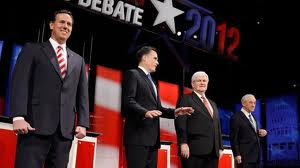
As the race for the 2012 Republican nomination heats up, I thought it would be appropriate at this time to take a closer look at the four contenders who remain. Former Massachusetts governor Mitt Romney, who has long been dubbed the proverbial front-runner, now faces a challenge from former House Speaker Newt Gingrich. Much of the Gingrich surge can be attributed to the personal attacks that Gingrich has leveled against Romney as a result of Romney's association with Bain Capital. Also, many Republicans are looking for a candidate who can go toe to toe with President Obama in the upcoming general election campaign. To many voters, that candidate is Gingrich. Many republicans simply feel as though Mitt Romney is not "tough enough" to take on the president. Despite the fact that Gingrich is viewed as the tougher of the two politically, many voters believe that Gingrich has too much "personal baggage" to win the nomination. As many know, the former speaker resigned his leadership position in the House due to a number of ethics violations. Much has also been made of Gingrich's three marriages, with his second wife alleging that Gingrich asked her for an "open marriage." Campaigns usually come down to the public's perception of a potential candidate. It will be very interesting to see if voters pay much attention to Gingrich's past when determining whether or not they will vote for him. Rick Santorum and Ron Paul, although still in the race, will most likely be non-factors as the race moves forward. Santorum recently stated that his campaign is broke, and he is tired, but vows to press on. Ron Paul has not seriously contested the race in Florida, and has turned his attention to upcoming caucus states such as Nevada and Maine. As a self proclaimed political junkie, it has been quite refreshing to see the energy and enthusiasm that Paul's campaign has generated. Ron Paul's message has resonanted with millions of Americans, especially younger voters. Unfortunately for Paul and his supporters, the media and those within the Republican party simply don't view his candidacy as legitimate. It is my belief that Mitt Romney will be the eventual nominee of the Republican Party. Although Romney doesn't have widespread support among true conservatives within the Republican ranks, he has gained the support of many members of the so called Republican establishment, namely Arizona senator and former Republican nominee, John McCain. Romney has also received the endorsement of former Kansas senator and 1996 Republican nominee Bob Dole. Without the support of the Republican base, and many members of the Republican establishment, combined with his personal issues, I just find it difficult to see a pathway to the nomination for Newt Gingrich. As mentioned earlier, Santorum and Paul both are non-factors at this point, and neither will be the nominee of the Republican Party. That leaves Romney as the last man standing to take on President Obama in November.

Sunday, August 28, 2011

A monument fit for a King


Today marks the forty-eighth anniversary of Martin Luther King Jr's. famous "I Have a Dream" speech. The speech was delivered on the steps of the Lincoln Memorial during the March on Washington in 1963. As Americans, we owe a debt of gratitude to Dr. King for the work he did to help our nation overcome the evils of segregation and racial injustice in the 1950's and 1960's. From Birmingham to Selma, Selma to Montgomery, the work of Martin Luther King Jr. lives on. It was Martin Luther King Jr. who challenged us to look beyond one's color so that we could focus on one's character. Dr. King knew the journey towards racial equality would not be an easy one. We hear evidence of this in the last speech that Dr. King ever gave. It came on the night of April 3rd, 1968 in Memphis, Tennessee. In that speech, Dr. King famously said, "we've got some difficult days ahead. But it doesn't matter with me now. Because I've been to the mountaintop, and I don't mind. Like anybody, I would like to live a long life. Longevity has its place. But I'm not concerned about that now. I just want to do God's will, and he's allowed me to go up to the mountain, and I've looked over, and I've seen the promised land. I may not get there with you. But I want you to know tonight, that we, as a people will get to the promised land." With the opening of the Martin Luther King Jr. memorial this past week on the national mall in Washington D.C., our nation has finally paid tribute to one of it's most influential leaders. I can't think of someone more deserving of such an honor, an honor that is long overdue. Very few, if any, have changed the course of history the way that Martin Luther King Jr. has. While King spoke of longevity in life, he was never able to achieve it. The memorial honoring Dr. Martin Luther King Jr. will not only provide the longevity that King sought in life by immortalizing the work of the late civil rights icon, it will also cement his legacy as a drum major for justice.

Wednesday, August 10, 2011

Crisis in Somalia


The situation is becoming more serious by the day in the east African country of Somalia. The region is experiencing one of the worst famines since the 1990's. Thousands of Somalis, including children, are dying from lack of food and water. When crises such as the current one in Somalia emerge, the United States never hesitates to offer our support . Some might say that the United States should take action now to help end the suffering for the people of Somalia. Given the current financial state of our country, one has to ask if we have the means to offer the necessary humanitarian support? There are many in America who would suggest that it is time for the United States to start taking care of its own people. Rather than worry about those who are starving in Africa, we should worry about those who are starving right here at home. The people of America are a kind and generous people. Many of us have a strong desire to want to reach out and assist those who need it the most. For hundreds of years, the United States has been a beacon of hope to so many nations in need. Despite the economic difficulties that we face, I believe that it is important that we never lose sight of that fact. Under the current circumstances, those of us in America who might want to assist the people of Somalia, might have to do so on our own. Private donations and offerings may be the best way to lend our support. A multi-billion dollar relief package from the U.S. government is just not possible at this time. As the crisis in Somalia continues, it is important that we continue to show concern and compassion for the people of this country in their time of extreme need.

Tuesday, August 9, 2011

The resignation of Richard Nixon


"Therefore, I shall resign the Presidency effective at noon tomorrow." These words were spoken by President Richard Nixon thirty-seven years ago today. With these words, Richard Nixon became the first  and only president in U.S. history to resign. As most people know, Nixon's resignation came in the aftermath of the Watergate scandal. Following the break-in at the Watergate office complex, President Nixon denied any involvement, and claimed that he had no knowledge of what had taken place. President Nixon was eventually implicated in the scandal, and made the decision to resign on August 9, 1974. History has shown that President Nixon did not reach this decision easily. He was determined to stay in office despite all of the controversy surrounding him. Ultimately, the outside pressures became too much, and facing certain impeachment, the President did the only thing that he could. While I am disappointed in the actions of President Nixon, I commend him for his decision to resign. He knew the implications that impeachment would have on the nation, and he didn't want to put the American people through that. In his resignation speech, President Nixon stated that America needs a full time President. He knew he could not effectively govern the nation while facing impeachment. Presidents often speak about what their legacy will be. Almost every President wants history to remember them fondly. Unfortunately, Richard Nixon's legacy will forever be linked to the scandal that was simply known as Watergate.

Monday, August 8, 2011

Does religion have a place in the political world?


Does religion have a place in the political world? It is a question that dates back to the beginning of our republic, and has been one of the most hotly debated topics ever since. As a supporter of the concept of separation of church and state, I personally believe that a politician's religious views should not influence their decision making. Likewise, a religious organization should not use its position to influence one's political thinking.  We have to have a mind of our own. We have to be able to think for ourselves. One might ask, why have religion and politics become so intertwined? The answer lies in the fact that certain political issues have serious moral and ethical implications in the eyes of some. For example, abortion violates one of the most sacred commandments, "thou shalt not kill." Opponents of gay marriage would most likely say that their opposition is due in large part to the fact that the bible says homosexuality is a sin. I have visited a church where the pastor/priest used the pulpit to try to influence the political thinking of the congregation. I told my wife, never again. Never would I step foot in that church again, and so far I haven't. I have a lot of respect for those who have a deep faith. I consider myself a deeply religious person. However, there is a time and place for everything. In my view, church is not the time, nor is it the place to try to influence one's political beliefs.